Social Casino Marketing & Industry Trends 2026: The B2B Report
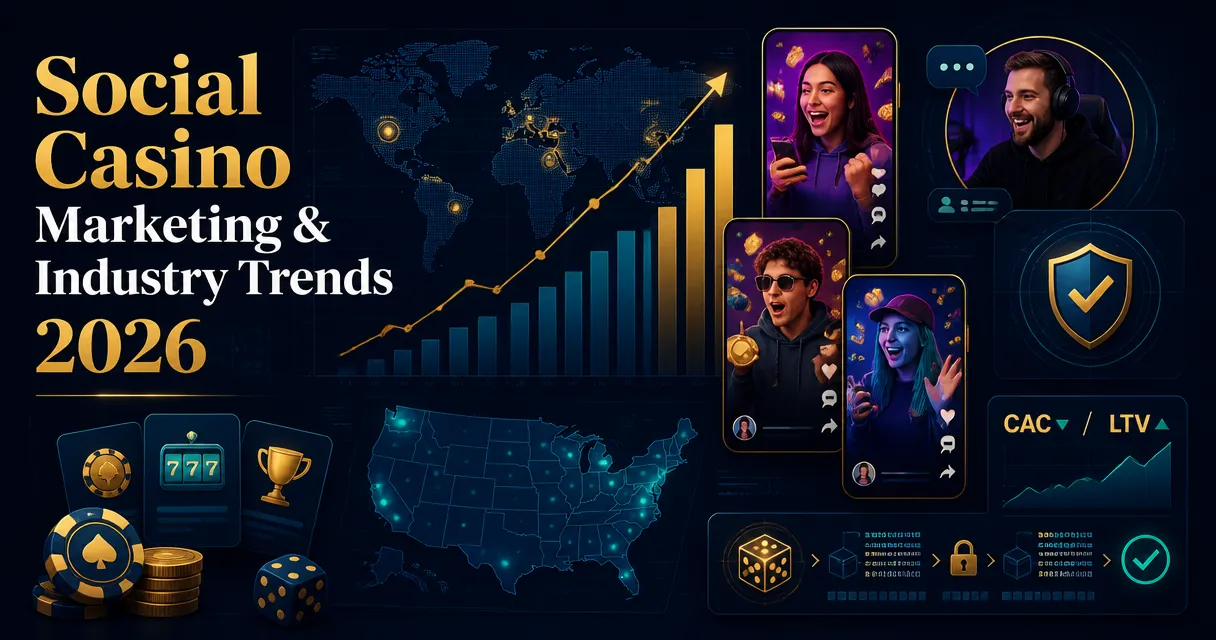
A working reference for operators, growth marketers, affiliates, and analysts covering the social & sweepstakes casino category. Six themes define 2026: the UGC pivot, short-video acquisition, the Stake.us model going mainstream, compliance-first creative, redemption speed as a moat, and the coming shakeout as state legislatures move.
Category snapshot: 2026 in numbers
- ~44 M monthly active social casino players in the U.S. (est.), up from ~36 M in 2024.
- Top 5 sweepstakes operators account for ~68% of category revenue — long tail is thinning.
- Median blended CAC across paid channels: $42–$78, depending on state and vertical.
- Median D30 retention on sweepstakes flow: 18–24% — significantly higher than pure free-play social slots (8–12%).
- Share of new signups coming from UGC / creator content: rising from ~11% (2023) to ~34% (2025) to a projected ~48% in 2026.
Figures are directional industry benchmarks synthesized from public earnings, category reports, and operator interviews. Ranges reflect the spread we observe, not any single source.
Trend 1 — UGC replaces polished paid creative
The category's dirty secret: high-production casino ads have been underperforming a scrappy, phone-shot creator clip for two years running. In 2026, the gap widens. Operators still shooting studio spots as the primary asset are paying 2–3× the effective CPI of their UGC-led competitors.
Why it works
- Trust arbitrage: "regular person shows their real redemption" beats any brand claim.
- Compliance friendly: a creator's personal experience is easier to disclaim than a brand promise.
- Cheap iteration: a creator can ship 40 variants in the time a studio ships 1.
The UGC brief that actually converts
- Hook in 1.5 s — a visual of the redemption receipt, not the game.
- Show the "no purchase" path explicitly (screen recording, not just voiceover).
- End on the daily bonus / free SC ask, never on a deposit CTA.
Trend 2 — Short video is the new performance channel
TikTok, Reels, and Shorts are no longer just awareness surfaces for this category. In 2026, TikTok Spark Ads (boosting an organic creator post) and Reels partnership ads are outperforming Meta feed placements on cost-per-signup for the first time.
Key mechanic: the creator's audience does the pre-qualification. A creator whose feed is "budget wins" or "sweeps daily bonuses" already indexed the interested users. The platform just has to serve the boost.
What's not working
- Rotating hosts on brand-owned TikTok accounts — engagement collapses after ~6 weeks.
- Reposting Instagram carousels to TikTok. The formats do not translate.
- "Influencer takeovers" of the brand account without creator equity in the outcome.
Trend 3 — The Stake.us model goes mainstream
Stake.us proved that a crypto-native, provably-fair, streamer-driven brand can win the social casino category on brand strength alone. In 2026, at least four Tier-2 operators are visibly copying the playbook: high-visibility streamer sponsorships, provably-fair game math, community-first Discord, and an aggressive UGC referral program.
Why the model is portable
- The "watch someone else play for real stakes" loop is universal — Twitch and Kick did the distribution work.
- Provably-fair math is a real trust signal in a category where trust is scarce.
- Community operations (Discord, Telegram) turn CAC into retention — same dollars, two jobs.
Why most who copy it will fail
The Stake brand was built over years of streamer relationships and a specific tone. Copying the tactics without the community operations discipline gets you the costs without the compounding.
Trend 4 — Compliance-first creative
Meta and TikTok tightened their gambling-adjacent ad reviews through 2025. In 2026, creative that leads with disclaimers, shows the "no purchase necessary" (NPN) path visually, and avoids "win money" language passes review at 2–3× the rate of the old "big jackpot" style.
- Lead with the NPN screen recording. Do not lead with the win.
- Never say "gambling," "cash," "real money," or "winnings" in copy — even where accurate.
- State restrictions on-screen for at least 1.5 s, not only in fine print.
Trend 5 — Redemption speed is the new moat
Player forums have professionalized. A single operator taking 6+ days to KYC and pay a redemption gets shredded on Reddit within a week, and paid channel efficiency drops noticeably. In 2026, sub-24-hour instant redemption via Skrill / ACH is table stakes; sub-2-hour is a real acquisition edge.
Practical implication: infrastructure spend on KYC automation and payout rails now returns more per dollar than an equivalent paid-media budget. This is a re-allocation story most 2024 plans didn't have.
Trend 6 — State regulation reshuffles the deck
California AB381, Washington enforcement, and pending activity in New York, Michigan, and Illinois are reshaping the addressable map. Operators that built a diversified state footprint (30+ states) absorb the shocks; single-state-heavy operators are exposed.
2026 planning should assume: 2–4 more state restrictions land, forcing geo-fencing, refund workflows, and creative re-cuts. Bake the ops cost in now, not later.
Benchmark table: CAC, LTV, redemption times (2026 estimates)
| Metric | Bottom quartile | Median | Top quartile |
|---|---|---|---|
| Blended CAC (USD) | $78–$120 | $42–$78 | $22–$42 |
| D7 retention | <22% | 28–34% | >40% |
| D30 retention | <12% | 18–24% | >30% |
| Median redemption time | >72 h | 18–36 h | <2 h |
| Share of signups from UGC | <20% | 30–45% | >55% |
| Compliance ad-approval rate | <35% | 50–65% | >80% |
Operator playbook: what to actually do in Q1–Q2 2026
- Move 30–40% of paid budget to UGC / creator whitelist. Keep the studio channel for brand — measure ROAS honestly.
- Ship 20 short-video variants a week. Structured brief, one creator lead, boost the winners with Spark / Partnership Ads.
- Cut redemption p50 to under 24 h. Automate KYC, add Skrill / ACH instant, publish the median time publicly. This is a marketing asset.
- Rewrite every headline for compliance-first. NPN visible in creative, no "win money" language, state disclaimers on-screen.
- Prepare a state-restriction playbook. Geo-fencing, refund workflow, creative re-cut kit, comms template. Ship it before the next headline hits.
- Invest in community ops. One Discord + one Reddit presence with real staff. This is the Stake model's non-obvious moat.
Frequently asked questions
Frequently asked questions
What is a social casino, in industry terms?
A social casino offers casino-style games (slots, dice, table games) using virtual currency. In the U.S., "sweepstakes" social casinos add a second currency (Sweeps Coins) that can be redeemed for real prizes under sweepstakes law — no purchase necessary.
How big is the social casino market in 2026?
Industry estimates put U.S. monthly active social casino players around 44 M in 2026, with the top 5 sweepstakes operators controlling roughly 68% of category revenue. Growth is real but concentrating.
Why is UGC outperforming paid brand creative?
Trust arbitrage. A creator showing a real redemption receipt outperforms any brand claim of "big wins." UGC is also easier to keep compliant and cheaper to iterate — creators ship 40 variants for the cost of one studio spot.
Is the Stake.us model actually replicable?
The tactics (streamer sponsorships, provably-fair math, Discord community) are replicable. The compounding effect isn't — it comes from years of creator relationships and community operations discipline that most operators underinvest in.
What does "compliance-first creative" mean?
Ads that lead with the "no purchase necessary" path, avoid "win money" or "gambling" language, show state restrictions on-screen, and use disclaimers as headline copy. This creative approval rate on Meta / TikTok is 2–3× higher than legacy "big jackpot" ads.
Why is redemption speed a marketing lever, not just an ops metric?
Player forums (especially Reddit) surface slow payouts within days. A slow-payout reputation drags paid channel efficiency down measurably. Sub-24-hour redemption has become a real acquisition edge and a public-facing brand asset.
How should operators prepare for more state restrictions?
Build a state-restriction playbook now: geo-fencing, automated refunds, a creative re-cut kit, and a public comms template. Assume 2–4 more states restrict or ban sweepstakes flows in 2026 and diversify the state footprint accordingly.
Who is this hub for?
Operator growth & marketing teams, category affiliates, investment analysts covering iGaming-adjacent stocks, and journalists tracking the social casino category. Player-facing content lives elsewhere on JackpotDaily.