
Is Social Casino Safe & Legit? The Trust & Transparency Center (2026)
Short answer: reputable U.S. sweepstakes social casinos are legal and reasonably safe to play — but "reasonably safe" is not the same as "risk-free." This page grades the category across six dimensions of safety, then gives you a personal checklist to protect your account, your data, and your bankroll.
This page is educational, maintained by JackpotDaily. It is not legal advice, not a certification of any operator, and not a substitute for reading each site's own terms and privacy policy.
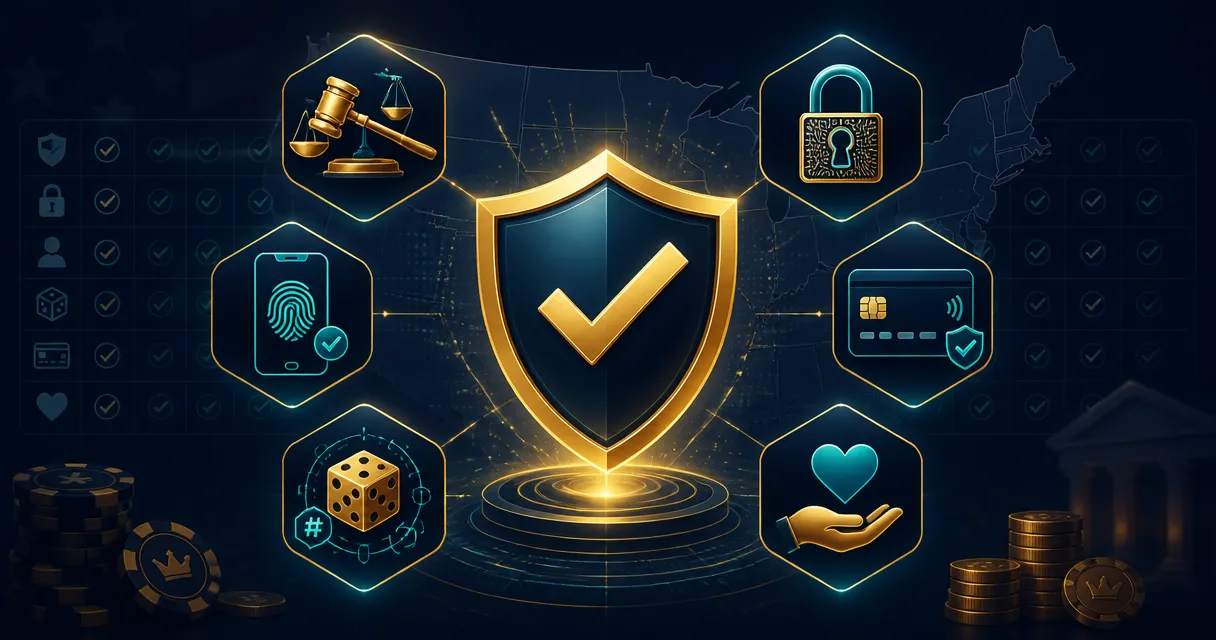
The 6-dimension safety scorecard
Any social casino should be scored on all six dimensions, not just the marketing headline. A site that pays out fast but shares your data with 40 ad partners is not "safe" — it's just fast.
| # | Dimension | What to check | Green flag | Red flag |
|---|---|---|---|---|
| 1 | Legal framework | Operating under U.S. sweepstakes law, clear state exclusions | Full list of ineligible states, NPN path documented | No state list; "play from anywhere" claims |
| 2 | Data protection | Privacy policy, encryption, ad-partner list | HTTPS everywhere, TLS 1.3, plain-English privacy summary | No privacy policy, or 30+ opaque ad partners |
| 3 | Account security | 2FA support, session controls, KYC flow | Optional 2FA (TOTP/email), device list, logout everywhere | No 2FA, no device visibility, password-only login |
| 4 | Payments & redemption | Payout rails, median redemption time, KYC clarity | ACH/Skrill in < 24 h, transparent KYC checklist | Vague "3–10 business days," moving KYC goalposts |
| 5 | Fair play | Third-party RNG audit or provably-fair math | Named auditor (e.g., iTech Labs, GLI) or seed verification | No audit disclosure, no math transparency |
| 6 | Responsible gaming | Self-exclusion, deposit/session limits, help resources | One-click self-exclusion, links to 1-800-GAMBLER | Buried RG tools or none at all |
1. Legal framework — sweepstakes law
U.S. sweepstakes social casinos operate under state sweepstakes and promotional-contest law, not real-money gambling regulation. The core legal requirement is "no purchase necessary" (NPN) — every player must have a free path to obtain Sweeps Coins and redeem prizes. Reputable operators publish the NPN mail-in or web form and honor it.
Some states are ineligible for redemption (commonly Washington, Idaho, Michigan; California under AB381; Nevada for most sweepstakes flows). A legit operator publishes the full ineligible-states list on the promotions page and enforces it at signup.
Deeper reading: No Purchase Necessary Hub · Legit & Safe Platforms Hub
2. Data protection & privacy
Social casinos collect a lot: name, date of birth, address, device fingerprint, and — for redemption — government ID and last-four SSN via KYC. That's more sensitive data than most retail apps. Three things to verify:
- Transport encryption: the entire site (not just checkout) should serve over HTTPS with modern TLS (1.2 minimum, 1.3 preferred).
- Data-sharing scope: the privacy policy should name categories of third parties and give you an opt-out for advertising cookies. A wall of legal boilerplate with no plain-English summary is a yellow flag.
- KYC data handling: reputable operators use a third-party KYC vendor (Jumio, Onfido, Persona) and don't store your ID scan on their own servers. This is usually disclosed in the privacy policy.
If a site does not have a privacy policy, or its privacy policy has not been updated since 2023, treat that as a serious flag regardless of how nice the games look.
3. Account security
Most social casino account takeovers we see reported on Reddit trace back to credential reuse — the player used the same password on a breached site years ago. Fix this once and you eliminate the top attack:
- Use a password manager. A unique 20-character password per casino.
- Turn on 2FA if offered. TOTP (Authy/Google Authenticator) beats SMS.
- Check the "active sessions" or "trusted devices" list monthly. Log out anything you don't recognize.
- Use a dedicated email address for casino accounts. If it ever gets phished, the blast radius is one inbox.
If a site offers no 2FA in 2026, that's a real gap — not disqualifying, but worth noting.
4. Payments & redemption safety
Payment safety has two parts: the money going in (purchases of Gold Coins) and the money coming out (Sweeps Coin redemptions).
Going in: use a virtual card or a low-limit card for casino purchases. This limits the damage if credentials are breached and gives you a clean chargeback path.
Coming out: the redemption path is where safety and speed meet. A reputable operator publishes:
- Median redemption time (sub-24 h is category-leading in 2026).
- Available payout rails (Skrill, ACH, e-check, sometimes crypto for social/sweeps hybrids).
- A KYC checklist you can complete before your first redemption — no moving goalposts.
See Withdrawal & Redemption Guide for the full process.
5. Fair play & game integrity
Two acceptable models exist in 2026:
- Third-party RNG audit. An independent lab (iTech Labs, GLI, eCOGRA) certifies the random number generator on a schedule. Certification pages should be linked from the footer, not hidden.
- Provably-fair math. Common in crypto-native and Stake-style operators. Each roll or spin exposes a server seed hash before the bet, and you can verify the outcome after. You don't need to trust the operator — you can check.
If an operator offers neither, the games may still be fair — but you're relying on faith, not evidence.
6. Responsible gaming
Social casino is entertainment. The tools that protect it as entertainment:
- Deposit limits — daily, weekly, monthly caps you set once and can only lower instantly (raising has a cooling-off period).
- Session & reality-check timers — pop-ups every 30–60 minutes to remind you how long you've played.
- Self-exclusion — one-click 24 h, 7 d, 30 d, or permanent lockout, ideally enforceable across the operator's brands.
- Help resources — link to 1-800-GAMBLER, the National Council on Problem Gambling (ncpgambling.org), or state helplines.
If any of these are buried three menus deep or missing entirely, that's a real red flag regardless of everything else.
Phishing & scam clones: how to spot them
Popular social casino brands are cloned constantly. The clone site takes your credentials, then either drains any real-money linked account or uses the login on the legitimate site to redeem your balance.
- Type the URL yourself. Never click social casino links from DMs, Discord, or paid ads.
- Check the domain. "chumba-casino.com" is not Chumba. "stake.us" is Stake — "stake-us.io" isn't.
- Look for the padlock and the domain. HTTPS only means the connection is encrypted, not that the site is legit.
- Never install an APK from a link. Get the app from the operator's website or the official store only.
Underage protection
Every reputable U.S. social casino restricts play to age 18+ (21+ in some states) and enforces this at signup, at KYC, and via device-level controls where available. Parents:
- Turn on iOS/Android device-level content restrictions (blocks "Gambling" category apps and sites).
- Use a family-account setup so purchases require parental approval.
- Talk about it. Social casinos advertise heavily on TikTok and Twitch — awareness beats blocks.
Your personal safety checklist
If you play social casino games, do these ten things once. They cover 90% of realistic risk.
- Verify the operator is on your state's eligible list.
- Use a dedicated email address for casino accounts.
- Set a unique 20-character password via a password manager.
- Turn on 2FA (TOTP if offered).
- Complete KYC before your first redemption, not after.
- Use a low-limit card or virtual card for Gold Coin purchases.
- Set a monthly deposit limit — even a high one.
- Read the privacy policy summary at least once.
- Bookmark the real URL. Never click social/DM/ad links.
- Save 1-800-GAMBLER in your contacts. Just in case.
Frequently asked questions
Frequently asked questions
Is playing social casino legal in the U.S.?
Yes, in most states. U.S. sweepstakes social casinos operate under state sweepstakes law with a "no purchase necessary" free path. Some states (commonly Washington, Idaho, Michigan, California under AB381, and Nevada for most sweeps flows) restrict or exclude redemption. Reputable operators publish the ineligible-states list.
Is my personal and financial data safe?
Reputable operators use HTTPS site-wide, third-party KYC vendors (Jumio, Onfido, Persona) for ID handling, and publish a privacy policy. Verify the privacy policy exists and is recent (2024 or later). Use a low-limit or virtual card for Gold Coin purchases to cap downside.
How do I know a social casino's games are fair?
Look for one of two things: a third-party RNG audit from a named lab (iTech Labs, GLI, eCOGRA) linked from the footer, or provably-fair math where each outcome exposes a server seed hash you can verify after the bet.
Can my social casino account get hacked?
Yes — but almost all reported account takeovers trace back to credential reuse from earlier breaches on other sites. A unique 20-character password from a password manager plus 2FA (TOTP preferred over SMS) eliminates the top attack vector.
Are social casino payouts real?
On regulated U.S. sweepstakes operators, yes — Sweeps Coins redeem for real prizes (cash equivalents, gift cards) via ACH, Skrill, or e-check. Median redemption on a well-run operator is under 24 hours in 2026; over 72 hours is a red flag.
How do I spot a scam clone of a real social casino?
Type the URL yourself, never click links from DMs, Discord, or ads. Check the exact domain — "chumba-casino.com" is not Chumba, "stake-us.io" is not Stake. Never sideload an APK from a link.
What responsible-gaming tools should a legit site offer?
Deposit limits (daily/weekly/monthly), session/reality-check timers, one-click self-exclusion with 24 h / 7 d / 30 d / permanent options, and links to 1-800-GAMBLER and the National Council on Problem Gambling. If any of these are buried or missing, that's a serious flag.
What's the biggest single safety upgrade I can make?
Two things, done once: (1) a unique 20-character password per casino from a password manager, and (2) 2FA enabled. Together they defeat the two most common real-world attacks — credential reuse and phishing pages.